.jpg)
.jpg)
.jpg)
.jpg)
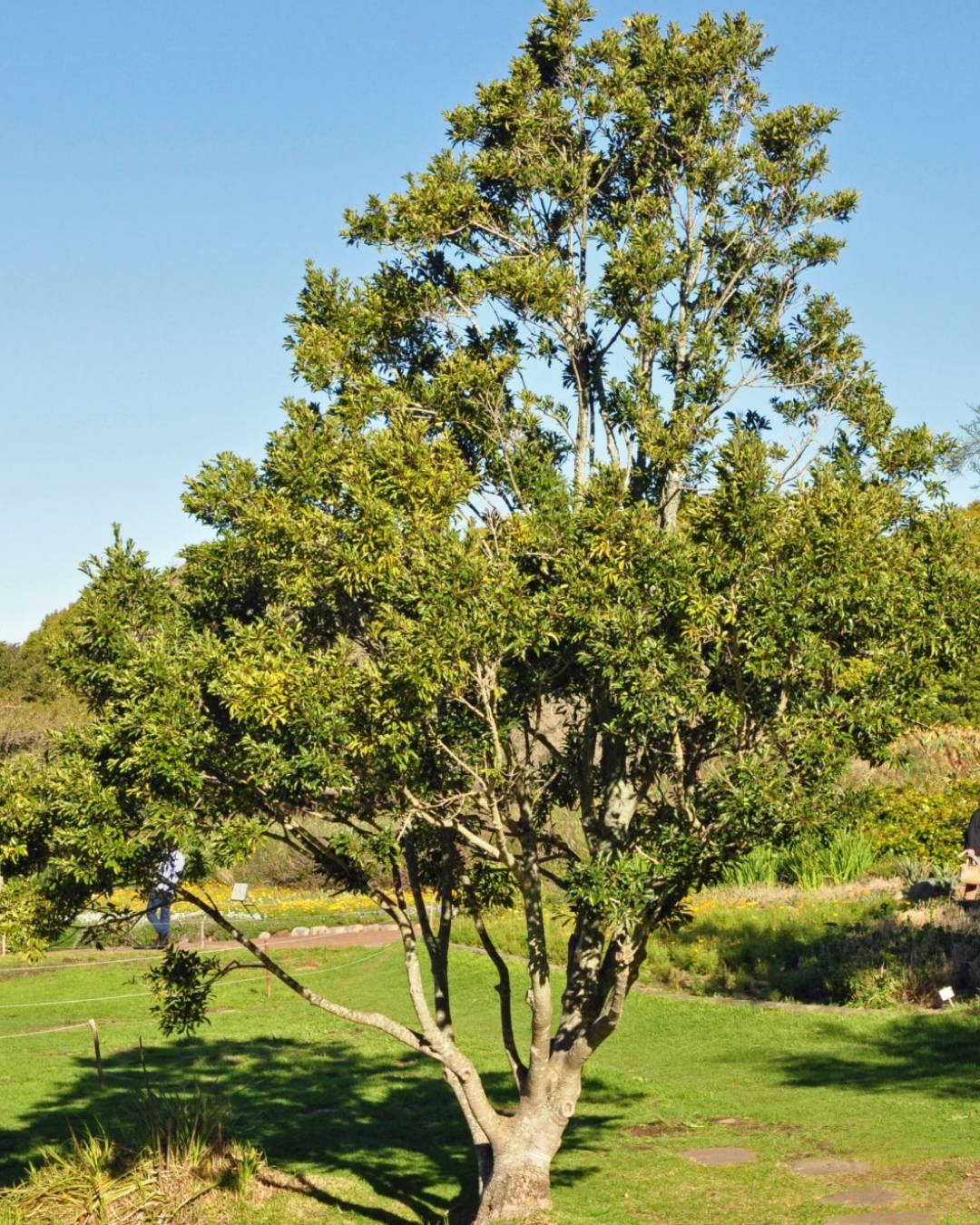
There are hundreds of holly species worldwide and exactly one is native to Africa. At a glance it looks like the hollies of the northern hemisphere, the ones on Christmas cards: dark glossy leaves, a dense rounded crown, and red berries through winter.
Then you look at a leaf. There are no spines. Northern hollies have the prickly, wavy-edged leaf everyone pictures, while this one is smooth all the way round. That is what mitis means, mild or unarmed.
The other differences are worth knowing. The leaf stalks are deep purple-red, new growth flushes a rich wine colour against the older foliage, and the bark is pale grey and often mottled white, which reads well in shade. Small white flowers open in the leaf axils through spring and summer, sweetly scented, and bees find them from a distance.
One practical point before you buy. Cape Holly is dioecious, with male and female flowers on separate trees, and only females carry berries. Plant a group if the fruit is what you are after. It is worth the trouble, because those berries are critical mid-winter food for Knysna turacos, African olive pigeons, bulbuls, mousebirds and barbets, arriving exactly when forest birds need them most.
The bark and leaves froth in water and have long been used as a soap for washing clothes and blankets, a use recorded in the tree's isiXhosa name, iPhuphuma. It carries ritual and medicinal weight in several traditions, used in cleansing preparations and as a remedy for fever. The wood is pale, fine and easy to work.
Plant it in semi-shade or full sun, and it grows happily in the shelter of larger trees. Water it consistently, because this is the one condition it will not bend on: dry ground kills it. Mulch heavily and compost annually to keep the soil damp while still draining. Prune lightly for shape, or clip harder if you want a dense screen. Use it in a damp corner, at a pond edge, on a stream bank, or at the low point where your garden drains. Choose something else for a dry Highveld garden without irrigation, since no amount of establishment will make this tree drought tolerant. Plant it close to paving or walls without concern, as the roots are well behaved and the size stays manageable.
We plant Cape Holly at Uilenkraal along stream banks and in the damp, shaded pockets of the forest where its need for consistent moisture is easily met. As a reliable canopy species that thrives beneath larger trees, it adds density and structure to the site's riparian zones, while its winter berries provide a critical food source for forest birds like Knysna turacos and African olive pigeons at exactly the time of year when other food is scarcest.
A Tree Card funds real tree planting in one of Greenpop's restoration projects. Browse our full range of designs, for any occasion, and find the right one for you.