.jpg)
.jpg)
.jpg)
.jpg)
.jpg)
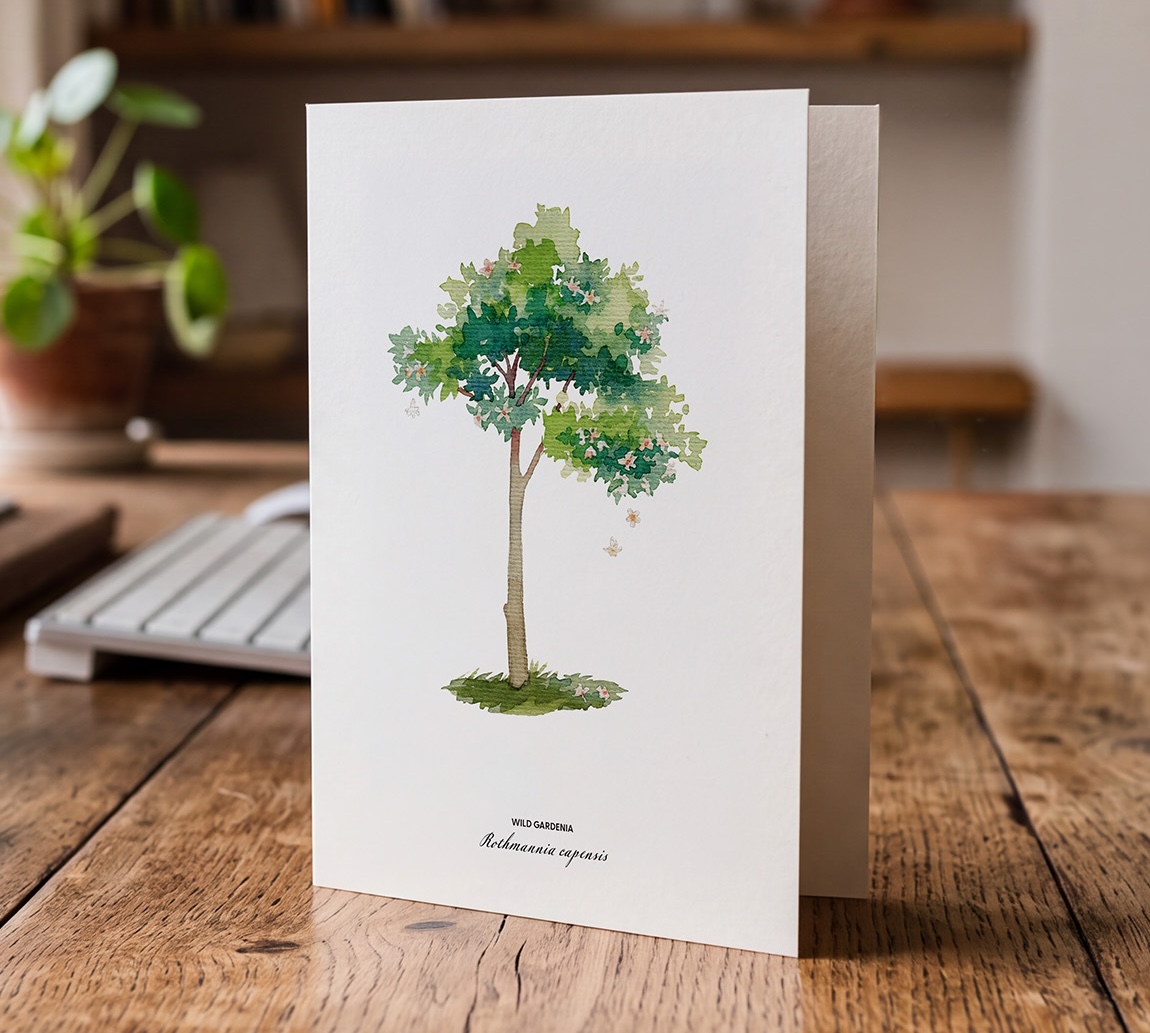
With its glossy, dark green leaves and large, trumpet-shaped white flowers, it's easy to mistake the Wild Gardenia for the cultivated gardenias sold at a garden centre — except this one's the indigenous original, blooming freely in South African forests long before anyone thought to plant a gardenia hedge. Its bark tells its own story with age, starting out smooth and pale grey-brown, then cracking into segments that look uncannily like crocodile skin. Look closely at the leaves, too, and you might spot tiny raised bumps along the veins — small shelters called domatia that house beneficial mites, quietly helping to keep the tree healthy.
The flowers themselves are a fleeting spectacle. Each one opens alone at a branch tip, lasts only a couple of days, and is deeply, sweetly scented — a fragrance so persistent it lingers even in flowers that have been picked and dried. Cream-white on the outside, they carry maroon streaks inside the throat that act as landing guides for moths and other pollinators. By late summer, those flowers give way to hard green fruit that slowly ripens to brown and can hang on the tree for months. It's technically edible, if unremarkable to a human palate — but baboons and vervet and samango monkeys clearly feel differently, descending on a fruiting tree with real enthusiasm (several of the tree's Afrikaans and indigenous names literally translate to "ape food"). Bushpigs, bushbuck, and grey duiker take care of whatever falls to the forest floor.
The wood has long earned its keep, too — hard and pliable enough to carve into cooking spoons, porridge sticks, and tool handles, and good, hot-burning firewood besides. In traditional medicine, powdered root has been used for rheumatism and leprosy, while warmed fruit juice was applied to wounds and burns. The tree even has a footnote in botanical history: it was among the South African species collected and shipped to Kew Gardens in London in the 1770s, decades before it was formally named after Swedish botanist Göran Rothman.
It grows well in full sun to semi-shade, thriving as an understorey tree beneath larger canopy trees but adapting well to more open positions too. Give it moderate water, keeping it consistent while young so it establishes, after which mature trees handle dry spells reasonably well. Pruning is minimal, and its non-aggressive root system means little maintenance is needed to protect nearby paving or structures. It works well in small gardens, either as an understorey specimen or a stand-alone accent tree, and does well in a large container with regular feeding. It is not a windbreak tree given its compact, rounded form, so plant it near a patio, doorway or window where its scent can be properly enjoyed.
We plant Wild Gardenia at Mistbelt as a slow-growing understorey species, well suited to establishing beneath the taller canopy trees on site rather than competing for the top layer. Its fruit is a genuine draw for the forest's wildlife, baboons and monkeys, including the Samango monkeys that live in Hogsback's forest canopy, alongside bushbuck and grey duiker feeding on whatever falls. Slow to establish but long-lived, it's a patient addition to the site's developing understorey, adding food and structure that a young, fast-growing forest doesn't yet have on its own.
A Tree Card funds real tree planting in one of Greenpop's restoration projects. Browse our full range of designs, for any occasion, and find the right one for you.