We believe that education is the cornerstone of a sustainable future. At Greenpop, we catalyse positive environmental impact through knowledge sharing, powerful storytelling, and inspiring people from all walks of life to become stewards of the natural world.
We cannot protect what we do not understand. Beyond simply "knowing facts", Environmental education is the process of building environmental literacy—the ability to interpret the health of an ecosystem and the agency to act on its behalf.
Effective environmental education achieves three critical outcomes:
It breaks down the "expert barrier," ensuring that conservation is not a niche pursuit but a universal right and responsibility.

It transforms individuals from passive observers into active managers of their local natural assets.

It sparks a series of informed daily decisions that aggregate into large-scale, long-term restoration.

Despite the escalating global environmental crisis, there remains a profound gap in functional environmental literacy. For many, "the environment" is seen as an abstract concept—something distant or separate from daily life—rather than the life-support system upon which all human activity depends.
This lack of literacy leads to a sense of powerlessness and inaction. Without an understanding of how ecosystems function or how individual actions scale into global impacts, it is impossible to foster the collective stewardship required for restoration. To move from apathy to action, we must first bridge the gap between information and understanding.
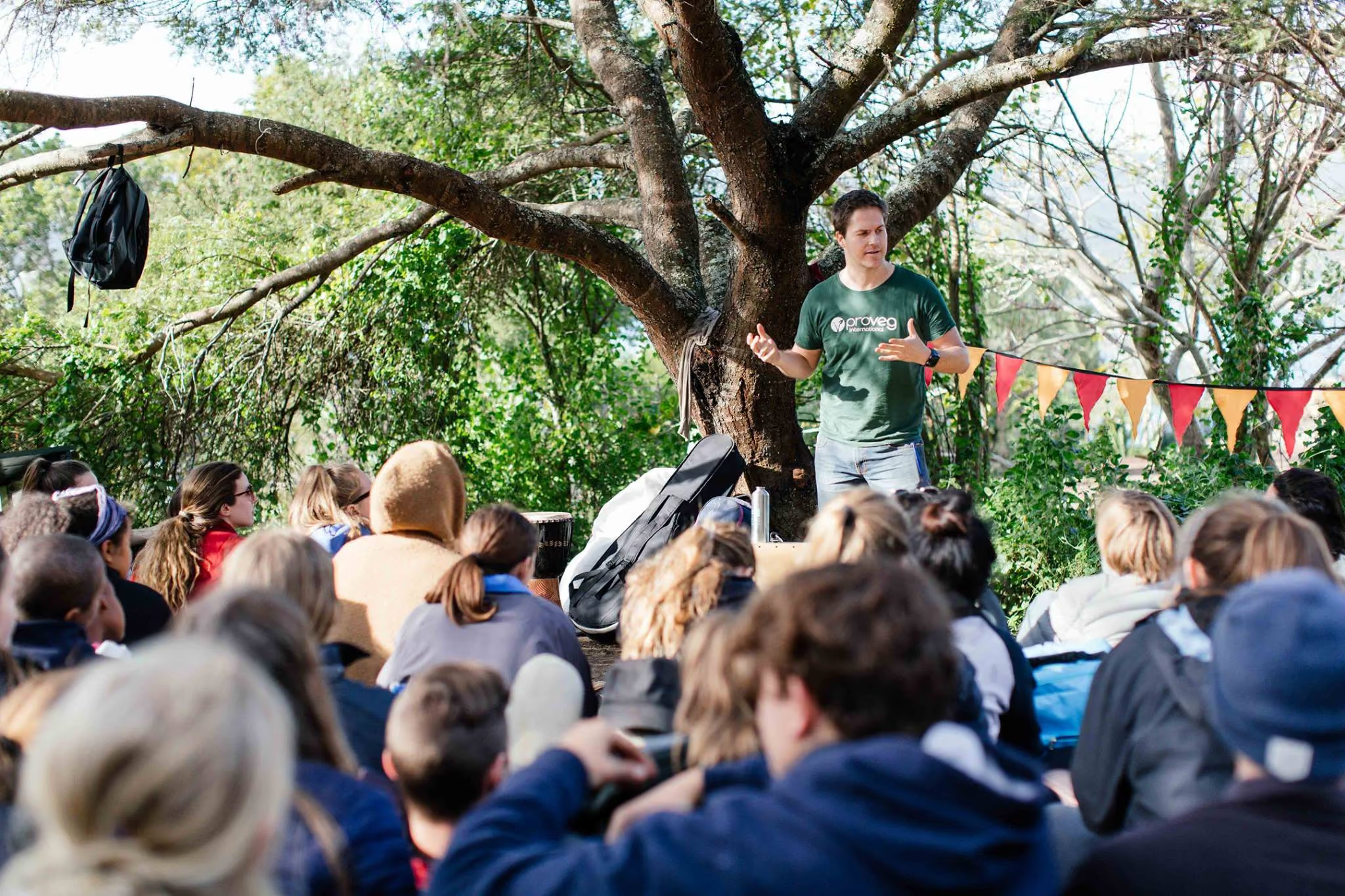
The need for increased environmental literacy is recognised globally as a prerequisite for a sustainable future. Our initiatives are strategically aligned with international frameworks to ensure local learning drives global targets.

We contribute to Sustainable Development Goal 4 (Quality Education) and Goal 12 (Responsible Consumption) by ensuring learners acquire the knowledge and skills needed to live in harmony with nature and promote sustainable development.
As an official partner, we support the global "Generation Restoration" movement by empowering individuals to move beyond awareness and into active participation in restoring our planet’s degraded landscapes.
We align with Target 21 of the GBF, which mandates that the best available data and knowledge are accessible to the public to guide effective biodiversity conservation and stewardship.
To bridge the literacy gap, Greenpop utilises an Environmental Education (EE) framework developed by Monroe, Andrews, and Biedenweg (2007). This model organises our strategies into four nested categories based on their objectives: conveying information, building understanding, improving skills, and enabling sustainable actions.
Rather than seeing communications and education as separate, this model views them as part of a spectrum which includes four levels of interaction, participation, and behaviour change:

Disseminating facts and raising awareness through one-way communication, such as high-impact digital campaigns, public art, music and film.

Facilitating a two-way exchange of ideas to clarify issues and generate concern through workshops, VR experiences, and guided nature walks.
Building technical capacity and modifying social norms through "learning by doing" activities like citizen science, technical training, and volunteer service.

Building transformative capacity for leadership and creative problem-solving through the facilitation of learning networks and community partnerships.
Since 2012, we have been sparking conversations and changing mindsets across Sub-Saharan Africa and beyond.


At Greenpop, Environmental Education is not a standalone pillar — it is the foundation that underpins every project we undertake. Whether we are restoring a forest, greening an urban school, or hosting a festival, we ensure that every action serves as a classroom for stewardship. However, the initiatives highlighted below are our specialised flagships where Education and Awareness are the primary goals.
Purpose: Enable action
A pioneering pilot with UNEP using gamified learning via a WhatsApp chatbot to empower young people in South Africa and Kenya to lead actions in biodiversity conservation.
Learn morePurpose: Build understanding
A virtual museum set in a future without single-use plastics, blending technology with environmental murals, this VR experience allows users to explore a world where humanity successfully restored the balance.
Purpose: Enable action
Part of the Global Landscapes Forum, this local chapter fostered collaboration and climate justice across South Africa's diverse communities.
Purpose: Improve skills
Empowering urban households with the technical skills to grow nutritious food in their own backyards.
Purpose: Convey information
A collaborative project using public art, indigenous planting, and sculpture to transform disused urban corners into vibrant hubs for community connection and dialogue around local biodiversity.
Purpose: Convey information
Cool as Folk was a series of fundraisng and awareness raising concerts held in Cape Town, Johannesburg and Pretoria headlined by Greenpop's co-founder Jeremy Loops.
Purpose: Convey information
Informative and provocative digital advocacy designed to challenge perceptions and ignite global conversations.
Every hectare restored, every indigenous tree planted, and every partner we support is powered by people like you. Join the movement to heal landscapes and secure a thriving future for all.
Ready to get stuck in? We host regular workshops at our nursery on a variety of environmental topics — from soil health to indigenous gardening.
We are always looking for partners to help us scale our impact. Let’s collaborate to fund or develop a nature-based educational project, digital asset, or awareness campaign.

Be the first to hear about new educational resources, upcoming campaigns, and project milestones. Sign up for our newsletter to stay connected.